Residential Asphalt Paving Project | Salem, Missouri
9,000 Sq. Ft. Driveway Paving & Drainage Project in Salem, MO
We Think of Everything: Drainage, Grading and Asphalt Paving
View the Asphalt Driveway in Progress
Watch the drone footage to appreciate the full size and design of this residential paving project. The aerial view shows the approximately 9,000-square-foot driveway, flowing curved edges, circle turnaround, roadway connection, and newly paved surface near the home.
It also shows how the driveway’s design works with the property’s natural layout rather than imposing rigid, straight lines.
Paving Project Summary
Titan installed approximately four inches of compacted asphalt, creating a smooth, attractive, and durable driveway built to last.
Years of stormwater runoff had left this rural driveway entrance muddy, rutted and difficult to use. Before paving the approximately 9,000-square-foot driveway, Titan designed and installed a drainage solution, precisely graded the surface and completed the project with more than 225 tons of premium-grade asphalt.
The result is a properly drained, substantial asphalt driveway featuring graceful curved edges, a circle turnaround and approximately four inches of compacted asphalt.
Project at a Glance
Location & Property
Drainage correction, grading and asphalt driveway paving
Driveway Size & Design
Approximately 9,000 square feet with curved edges and a circle turnaround
Drainage Improvements
French drain, drain tile, gravel drainage pad and laser grading
Asphalt Installation
More than 225 tons of BP-1 premium-grade asphalt
Compacted Thickness
Approximately 4 inches
Project Schedule
Asphalt paving completed over two days
More Than a Paving Project
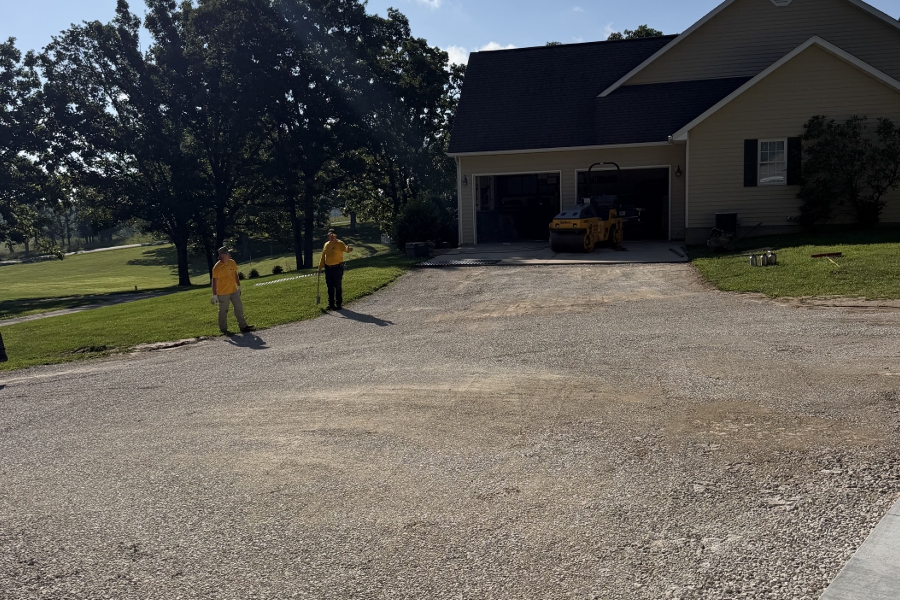
The homeowners came to Titan after receiving a recommendation from a friend whose driveway we had previously paved. They were ready to replace their gravel surface with asphalt, but they understood that paving alone would not solve the property’s most serious problem.
For years, stormwater had traveled down the roadside ditch and settled at the driveway entrance. The standing water created a soggy surface, mud, ruts and accumulated debris. Snow and ice made the entrance even more difficult to navigate during the winter.
Other contractors had not provided a dependable solution. Before investing in a new asphalt driveway, the homeowners wanted confidence that the underlying drainage problem would be corrected properly.
That is where Titan’s ability to coordinate drainage, grading and asphalt paving became especially valuable. Rather than covering the problem with asphalt, we developed a comprehensive plan to correct the water movement first and then construct the new driveway over a properly prepared surface.
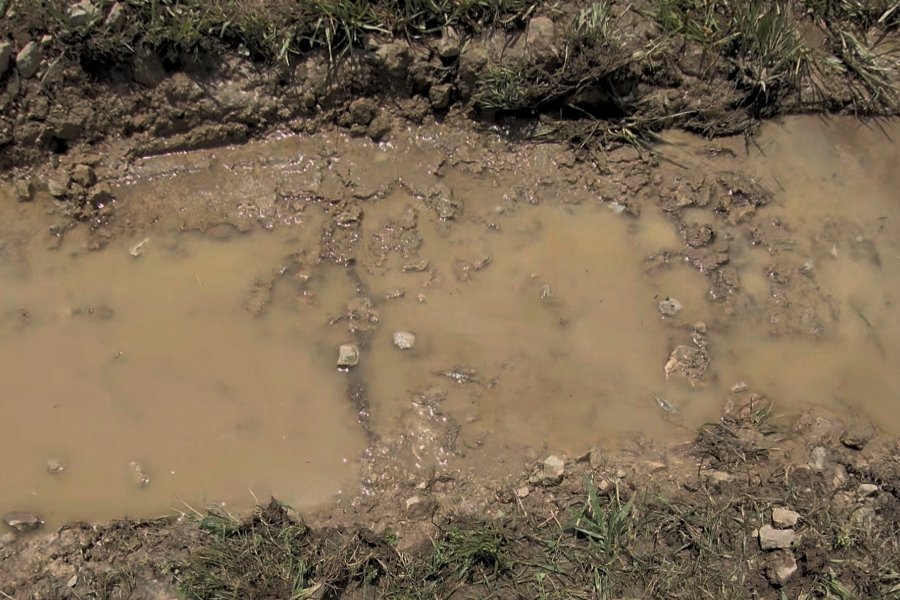
Stormwater traveled down the roadside ditch and collected where it reached the driveway entrance.
Correcting Years of Water, Mud and Driveway Damage
Stormwater running through the roadside ditch had nowhere to go when it reached the driveway entrance. The water repeatedly settled into the gravel surface, leaving it soft, muddy and vulnerable to recurring damage.
The homeowners dealt with ruts, debris and unstable entrance conditions for years. During colder weather, the retained water also contributed to snow and ice problems.
Paving directly over the area without correcting the water movement could have allowed moisture to continue saturating or eroding the driveway base. Over time, that could contribute to settling, cracking and premature pavement deterioration.
Before designing the asphalt driveway, Titan needed to understand:
- Where the water originated
- How it moved through the roadside ditch
- Why it settled at the driveway entrance
- How much natural slope was available
- Where the collected water could be safely redirected
- How the drainage system would interact with the new asphalt
Correcting the source of the problem was essential to protecting the homeowners’ paving investment.
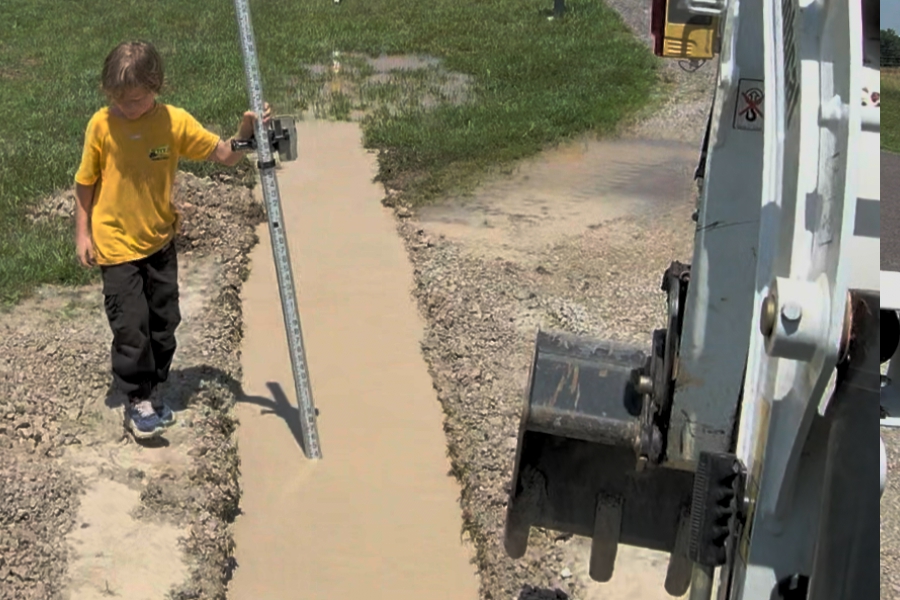
Titan evaluated the existing elevations and water flow before developing the drainage and paving plan.
On-Site Drainage Assessment and Project Planning
Titan began with an on-site drainage assessment and planning consultation. We examined the driveway, roadside ditch, surrounding elevations and available paths for redirecting the water.
The assessment revealed a very tight grade of approximately one-half percent. With so little natural slope available, the drainage elevations needed to be calculated and established carefully. Even a relatively small grading error could prevent water from moving as intended.
Titan worked with the homeowners to develop a solution involving:
- Fine laser grading
- Drain tile
- French drain installation
- A gravel drainage pad
- PVC drainage pipe
- Carefully selected discharge locations
- Surface grading coordinated with the new asphalt
The homeowners reviewed the recommended plan and felt confident that it addressed the underlying drainage problem—not simply the visible mud at the surface.
A Drainage Plan Tested by Rain
Rain arrived almost immediately after Titan completed the drainage work, providing an early real-world test of the new system.
Instead of collecting at the driveway entrance as it had for years, the water moved through the newly installed drainage system as planned. The homeowner reported that the system worked perfectly.
This successful test allowed Titan to proceed with the driveway preparation and asphalt installation with greater confidence.
French Drain, Drain Tile and Gravel Drainage Pad
Titan installed a coordinated drainage system designed to collect, control and redirect water away from the driveway entrance.
The solution included drain tile, French drain components, PVC drainage pipe and a gravel drainage pad. Fine laser grading helped establish the elevations necessary to move water through the system despite the property’s tight one-half-percent grade.
The gravel drainage pad helps receive and manage water where the roadside ditch meets the driveway. The underground drainage components then direct the collected water away from the entrance.
By completing the drainage work before the asphalt installation, Titan created better conditions for the driveway base and reduced the risk of recurring saturation beneath the pavement.
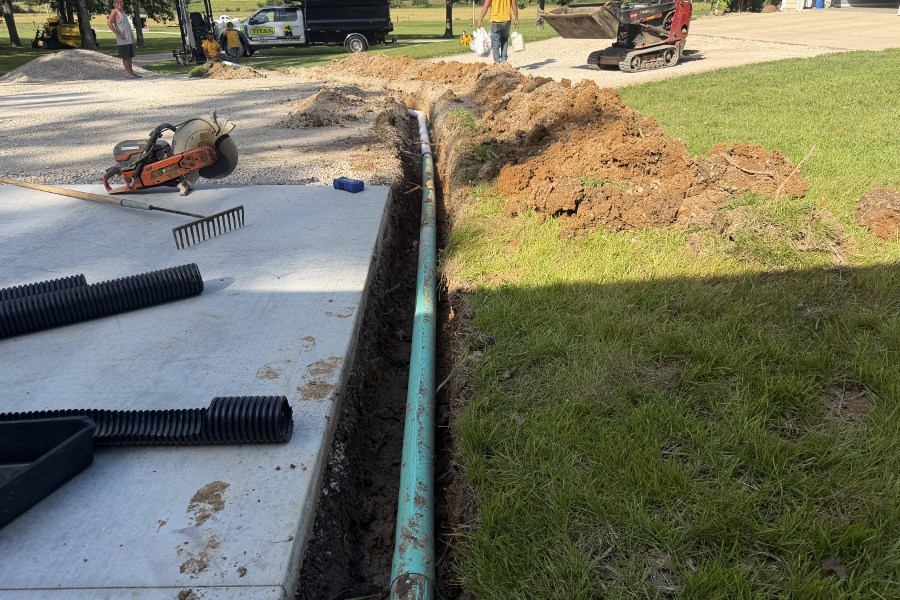
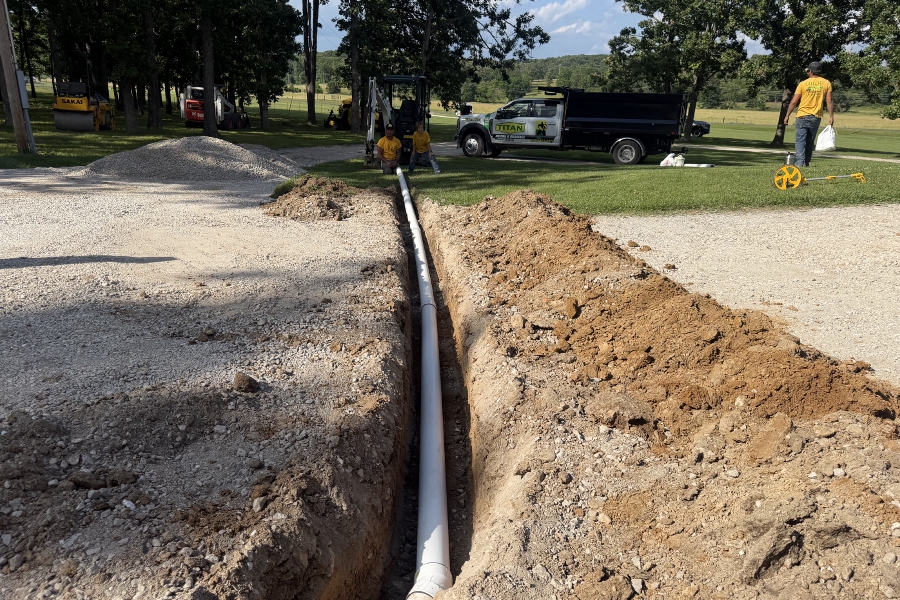
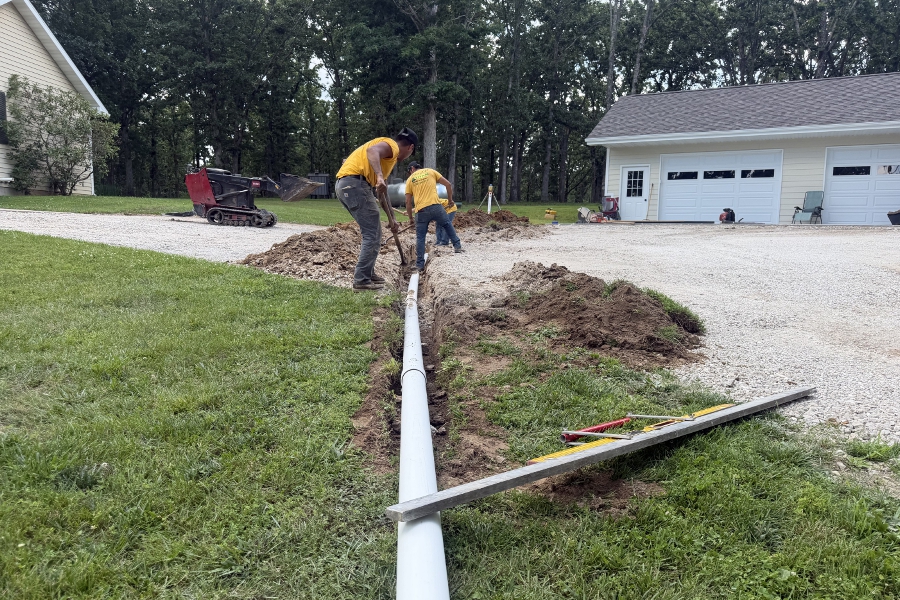
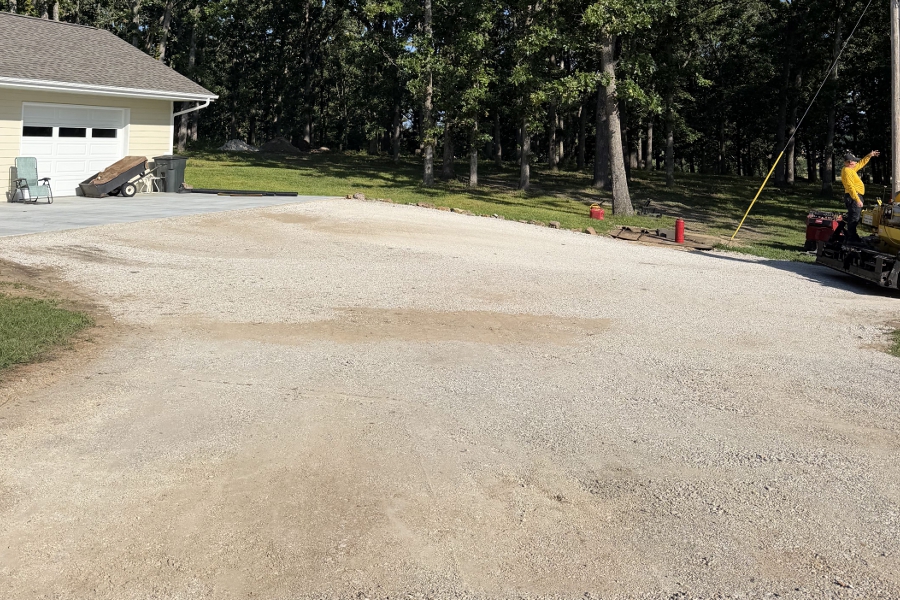
The graded driveway was prepared to support the asphalt surface and direct water toward the new drainage system.
Preparing the 9,000-Square-Foot Driveway for Asphalt
After confirming that the drainage system worked properly, Titan began preparing the approximately 9,000-square-foot gravel driveway for asphalt paving.
Gravel driveways commonly develop a raised center and lower wheel paths over time. Simply paving over these irregularities would not produce the smooth, properly graded surface the homeowners wanted.
Titan used a laser dozer with grading wings to reshape the driveway, remove the developed center hump and establish the grades needed for proper water movement. Special attention was given to the curved sections, circle turnaround, area near the home and roadway connection.
The preparation included:
- Reshaping the existing gravel driveway
- Removing the raised center hump
- Correcting soft or uneven areas
- Establishing proper surface elevations
- Preparing the curved driveway edges
- Grading the circle turnaround
- Preparing the roadway connection
- Coordinating the surface grade with the drainage system
- Applying full-strength prime coat/tack coat
Careful preparation created the foundation for a smoother and more consistent asphalt installation.
Two Days of Precision Asphalt Paving
Titan divided the asphalt installation into two days to provide sufficient time for the driveway’s curves, transitions, circle turnaround and roadway connection.
The goal was not to complete the project as quickly as possible. The goal was to give each area the time and attention required to produce a quality result.
Day One — Upper Driveway and Circle Turnaround
During the first paving day, Titan completed the upper portion of the driveway, the area near the home and the circle turnaround.
The homeowners specifically requested flowing curves instead of long, straight asphalt edges. Producing this design required additional machine positioning, careful edge formation and experienced handwork.
The crew also needed to coordinate adjoining paving passes while the asphalt remained hot enough to create strong, consistent connections.
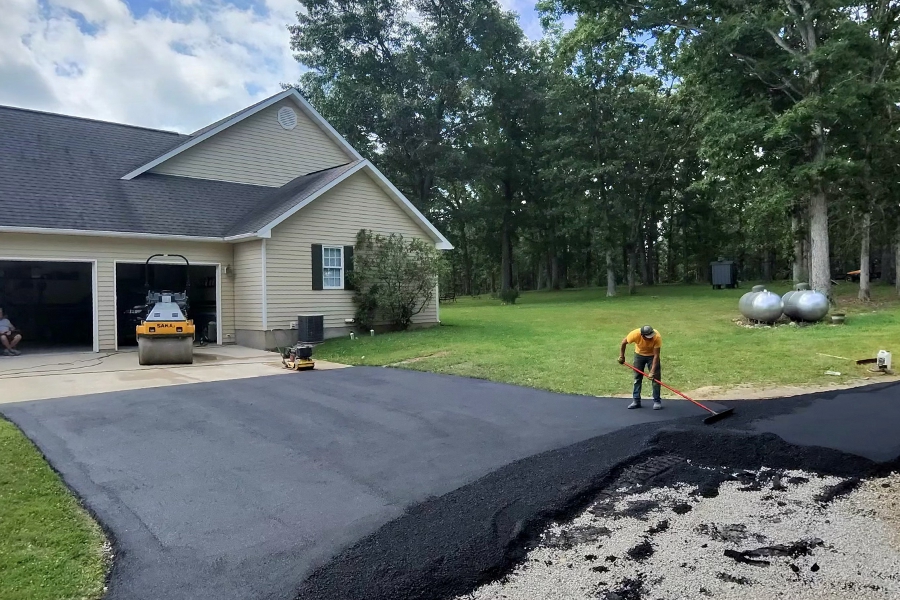 Day one focused on the upper driveway, the area near the home and the circle turnaround.
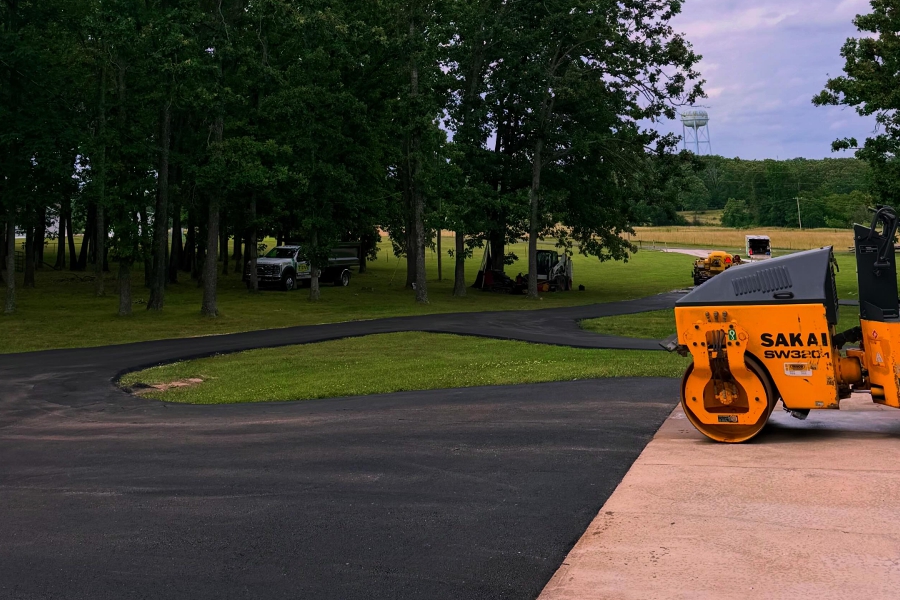 The circle turnaround required careful machine positioning, edge formation and coordination between adjoining paving passes.
Day Two — Main Driveway and Roadway Connection
On the second paving day, Titan completed the main length of the driveway, lower curved sections, driveway entrance and connection to the roadway.
The work at the entrance also complemented the drainage improvements completed before paving. Proper surface grading helps direct water toward the drainage system rather than allowing it to collect on the new asphalt.
Once the asphalt was installed, the crew completed the necessary rolling and compaction to create a strong, smooth finished surface.
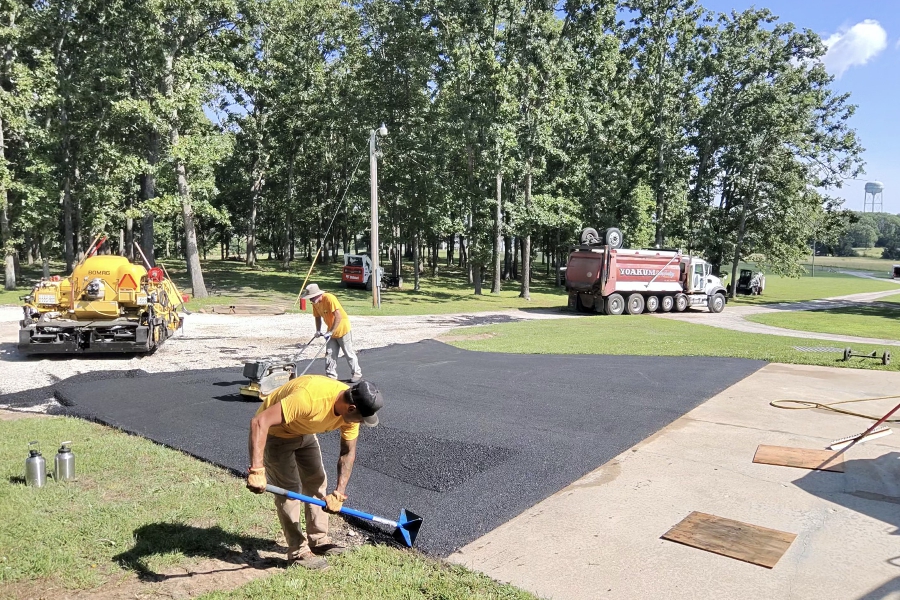 On the second day, Titan completed the main driveway and continued paving toward the roadway entrance.
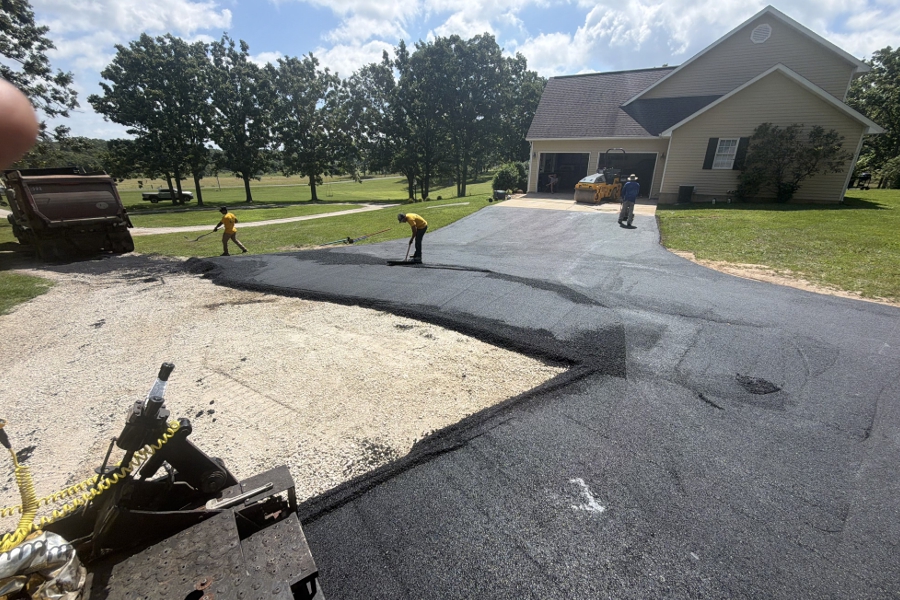 The finished driveway was carefully connected to the roadway and coordinated with the entrance drainage improvements.
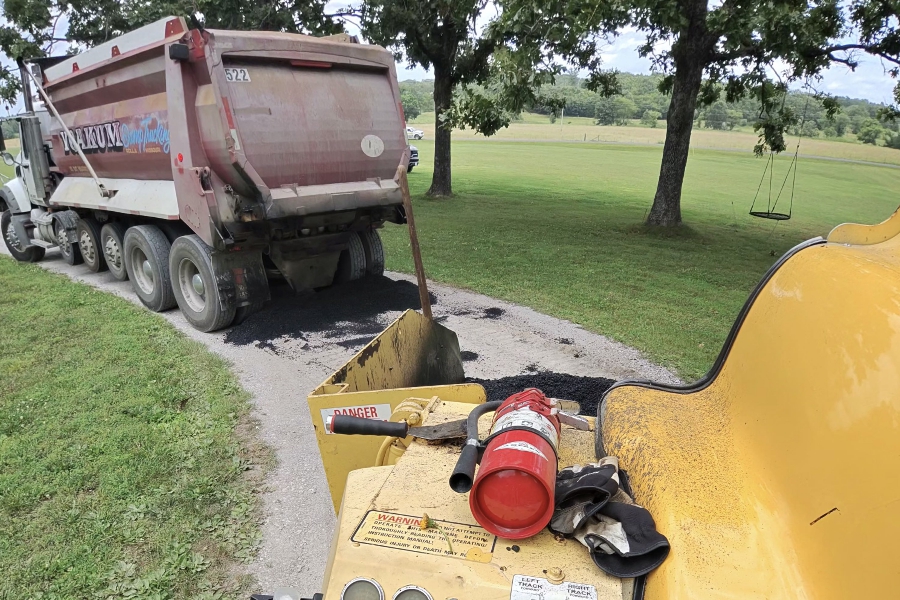
Because of the driveway’s curves and confined areas, the paver traveled to the staged trucks to refill its hopper.
Why This Driveway Required Specialized Paving Logistics
A long, straight driveway can often be paved by backing the dump truck directly toward the paver while the paver pushes the truck forward. This project’s curved design, confined areas and circle turnaround required a different approach.
Titan staged the Mack dump trucks on the driveway and moved the Bomag paver to each truck to refill its hopper. The paver then returned to the active paving area and continued the asphalt mat.
When the hopper was empty, the crew needed to raise the paver screed, return for more asphalt and carefully resume paving at the previous stopping point.
This process took more time than paving a simple, straight driveway, but it allowed Titan to work effectively within the property’s tighter areas and produce the curved design the homeowners requested.
Asphalt Paving Is About Timing
Successful asphalt paving is not simply about paving fast. It requires coordinating the asphalt plant, trucks, paver and rolling crew so the material arrives, is placed and is compacted at the correct temperature.
Hot asphalt can leave the plant at approximately 320 degrees. From that point forward, the entire paving operation must be carefully timed.
The asphalt must remain workable enough to:
- Feed through the paving machine properly
- Join adjoining paving passes
- Form clean edges
- Be raked and shaped where necessary
- Receive proper initial rolling
- Achieve the required compaction
- Receive the final finish rolling
The logistics become even more important on rural projects located farther from the asphalt plant. Titan coordinates trucking and paving operations to keep the “paving train” moving and minimize delays that could affect asphalt temperature or consistency.
Specialized Equipment for a Specialized Project
The quality of an asphalt driveway depends on skilled people, proper preparation and equipment suited to the work. Titan used specialized trucks, grading technology and paving machinery throughout this project.
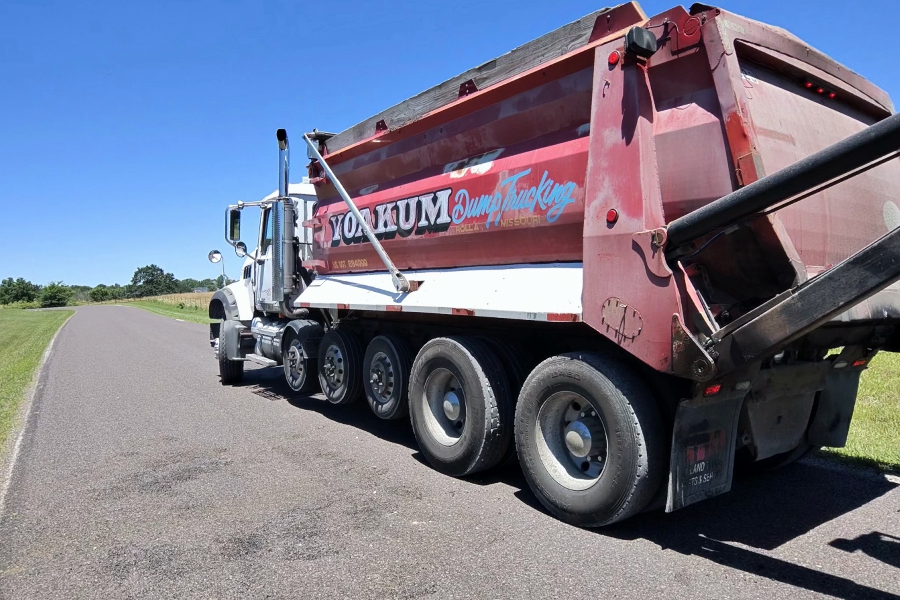 The truck’s elevated body and angled tailgate provide greater control while loading hot asphalt into the paver.
Mack Asphalt Dump Trucks
Titan prefers Mack dump trucks for their elevated bodies and angled rear tailgates, which provide greater control when delivering asphalt to the paver.
A conventional 90-degree tailgate may remain open longer as the truck body lowers. Titan’s angled tailgates favor a closed position, helping stop the flow of asphalt sooner.
The angled tailgate provides several advantages:
- Reduces asphalt spills
- Prevents asphalt from mixing with the gravel base
- Limits material waste
- Reduces cleanup between loads
- Helps maintain continuous paving operations
- Saves valuable time while the asphalt remains hot
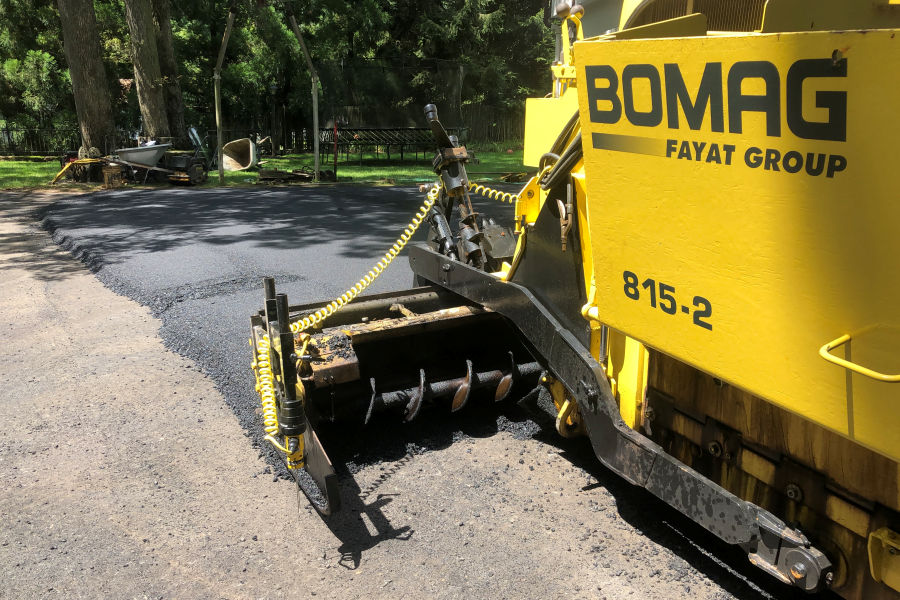 Titan’s computer-controlled BOMAG paver helps deliver smoother asphalt and consistent paving depth.
Computer-Controlled Bomag Asphalt Paver
Titan uses a BOMAG 815 paver equipped with an automated sonic grading system to help maintain consistent asphalt mat thickness.
The system monitors the prepared surface and adjusts the screed height as surface elevations change, helping the crew maintain the desired paving depth and produce a smoother, more uniform asphalt mat.
This technology is especially valuable when paving:
- Curved driveways
- Changing elevations
- Circle turnarounds
- Transitions near a home
- Multiple adjoining passes
- Roadway connections
The equipment supports the crew’s experience and helps create a smoother, more consistent result.
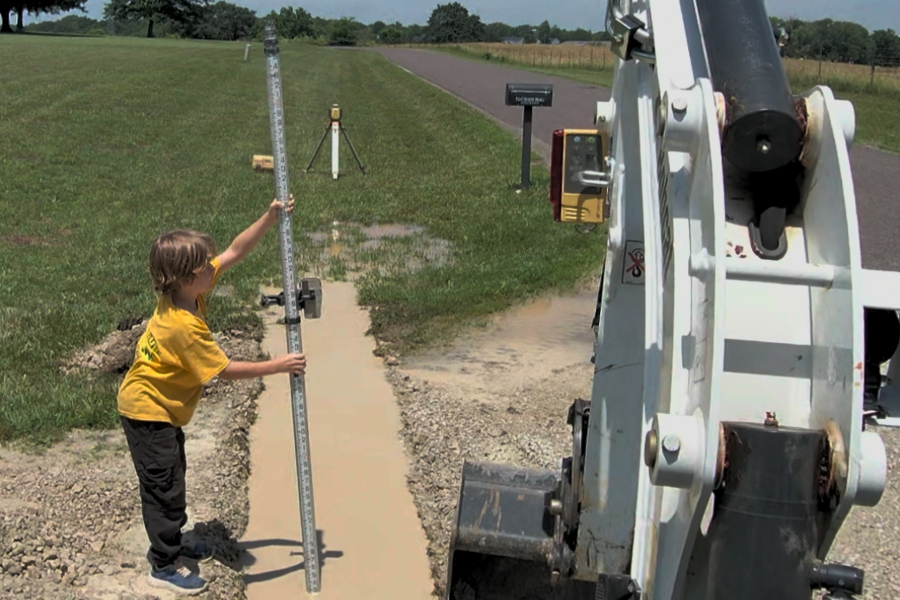
The graded driveway was prepared to support the asphalt surface and direct water toward the new drainage system.
Topcon Laser Grading Equipment
Titan used a Topcon laser transit and laser-guided grading equipment to establish the driveway and drainage elevations.
This precision was particularly important because the available drainage grade was only approximately one-half percent. Laser-guided measurements helped the crew create the elevations necessary for the drainage system and asphalt surface to work together.
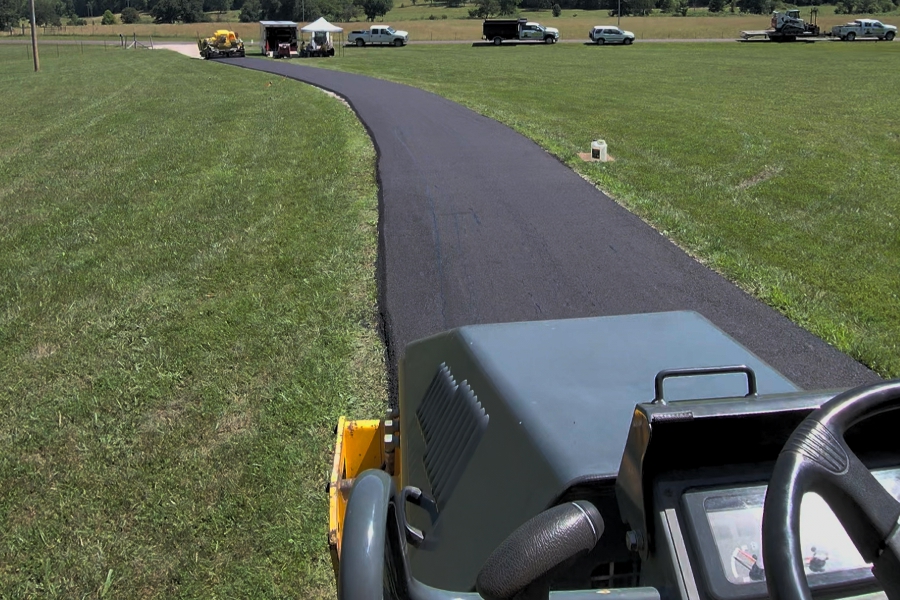
Properly timed rolling compacts the hot asphalt and contributes to the pavement’s strength and finished surface.
Approximately Four Inches of Compacted Asphalt
Asphalt thickness is one of the most important factors affecting the durability and expected performance of a paved driveway.
Titan used more than 225 tons of BP-1 premium-grade asphalt to produce a finished compacted depth of approximately four inches across the driveway.
Asphalt must initially be placed thicker than its intended finished thickness because rolling compresses the material. As a general guideline, approximately one-quarter inch of compaction can occur for each inch of asphalt initially installed.
For example, producing a three-inch compacted asphalt surface may require the paver to initially place approximately 3.75 inches of material.
Achieving the intended result depends on several factors:
- Asphalt temperature during installation
- Initial paving thickness
- Consistent material distribution
- Condition of the driveway base
- Timing of the rolling process
- Proper compaction
- Formation of the asphalt edges
- Quality of adjoining paving passes
- Final finish rolling
Installing more than 225 tons of asphalt reflects Titan’s commitment to providing the material depth planned for the project.
The Finished Salem Asphalt Driveway
The completed project transformed a muddy and unreliable gravel entrance into a smooth, substantial asphalt driveway designed around the property and the homeowners’ goals.
The finished driveway provides:
- Improved stormwater management
- A smoother and cleaner driving surface
- Approximately 9,000 square feet of pavement
- Approximately four inches of compacted asphalt
- Curved edges instead of a rigid rectangular appearance
- A functional circle turnaround
- A clean connection to the roadway
- Better access during rain, snow and ice
- A finished appearance that complements the property
- A safer walking surface
- Increased property value
Most importantly, Titan addressed the underlying drainage problem before paving. The drainage system, driveway grade and finished asphalt surface now work together as one coordinated solution.
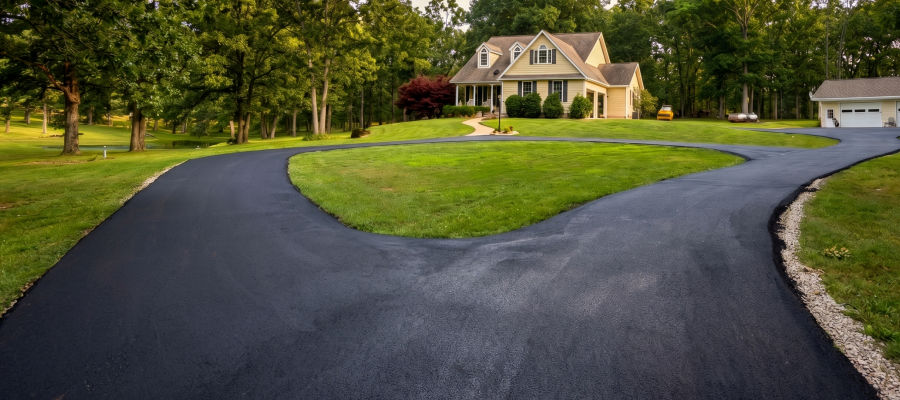 The finished circle turnaround provides convenient vehicle access and complements the driveway’s curved design.
What Our Customers Say
★★★★★
“Don did an excellent job with fixing my drainage problem in my yard. He was timely and did excellent work and cleaned up the site. He made sure I was satisfied with the work. I would highly recommend Titan paving and drainage”
-Jamie Wilson, Salem Mo. (Google Review)
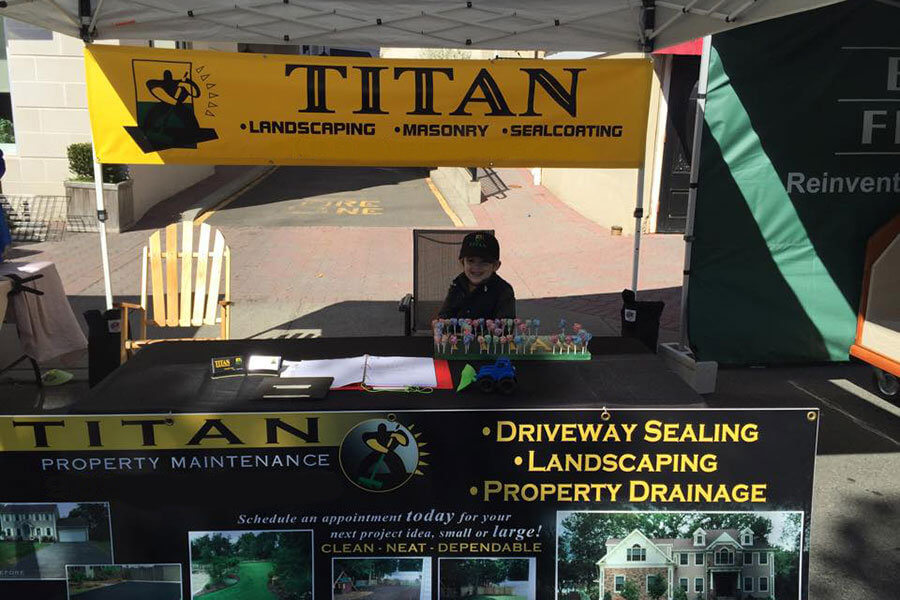
"Titan Up" Your Property Today!
The professionals at Titan have the wisdom, expertise and specialized equipment to diagnose and correct your property’s maintenance issues and enhance the appearance of your residential or commercial property. Don Mutz is committed to providing you with exceptional customer service and developing customized, cost-effective yard drainage, paving, landscaping and storm shelter solutions that will result in enduring improvements to your home or business. We consistently deliver outstanding results that earn us positive reviews from our clients.
Schedule Estimate
Call Titan today at (573) 453-6379 to learn how our property maintenance experts can enhance the appearance, safety and functionality of the property surrounding your home or business.